





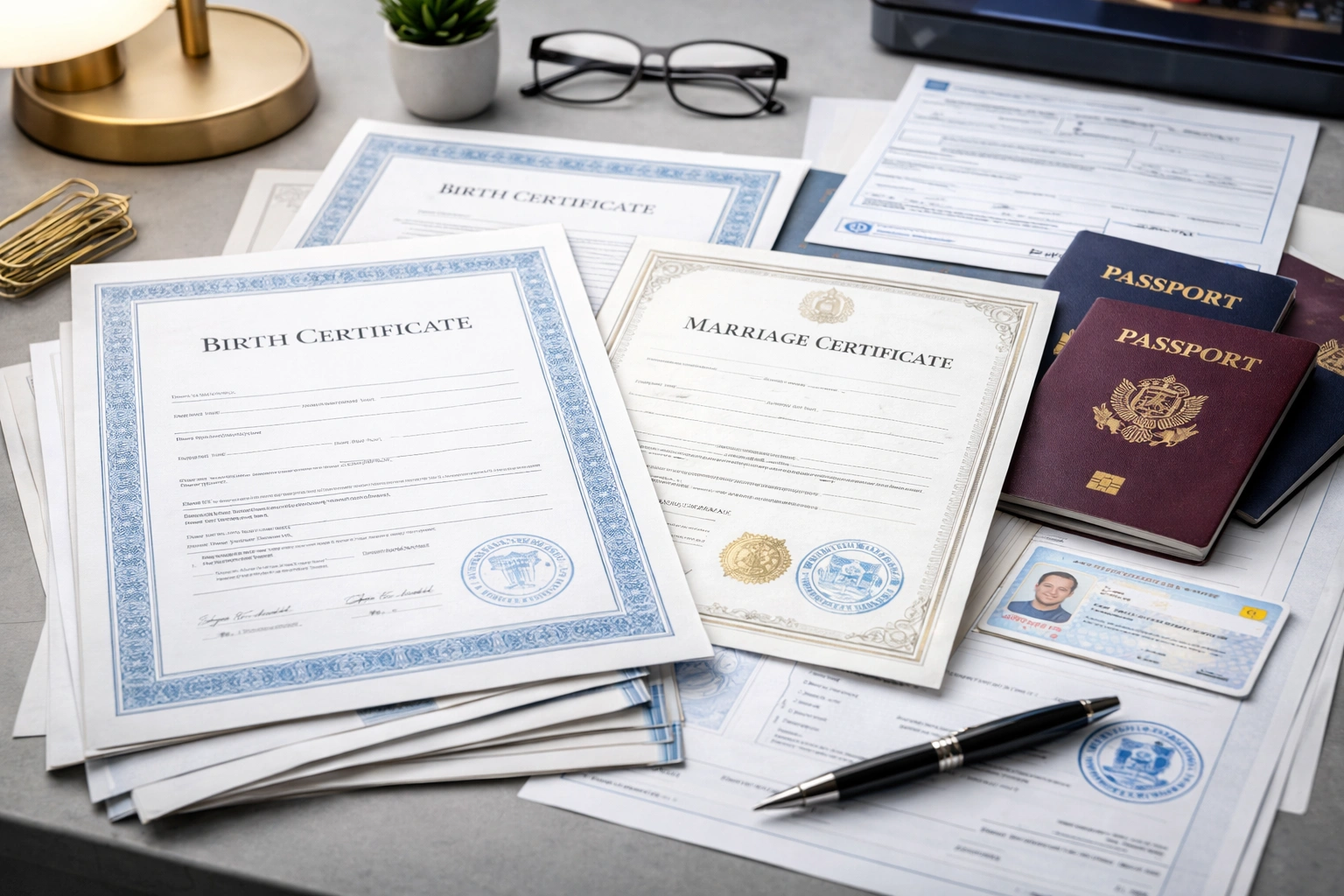
Document legalisation and apostille in Belgium and internationally
In today’s globalised world, it is often necessary to legalise or authenticate official documents so they are recognised by foreign authorities, institutions, employers, universities or business partners.
These procedures confirm the authenticity of your documents and enable them to be used abroad.
At Girolamo Translations, we guide our clients through every step of the legalisation and apostille process — for both personal and professional documents — whether in Belgium or internationally.

What are legalisation and apostille?
Legalisation
Legalisation is the official procedure used to certify the authenticity of a public document so that it is recognised in another country.
When the destination country is not a signatory to the Apostille Convention (the Hague Convention of 1961), a full legalisation procedure is required. This often involves several successive steps before the document can be accepted by the foreign authorities.
In Belgium, apostilles and legalisations are issued by the Federal Public Service Foreign Affairs. For countries that are not part of the Apostille Convention, the document must usually be legalised by the Belgian Ministry of Foreign Affairs before being presented to the consulate or embassy of the destination country.
Please note that the competent authority responsible for issuing apostilles or performing legalisation varies from country to country (e.g. Ministry of Justice, Ministry of Foreign Affairs, regional authorities, courts, etc.).
Apostille
An apostille is a simplified legalisation procedure established by the Hague Convention of 5 October 1961. It replaces the lengthy traditional chain of legalisations between signatory countries.
The apostille is an official certificate attached directly to the document (or included as an annex). It certifies the authenticity of the signature, the authority of the signatory, and — where applicable — the seal or stamp on the document.
⚖️ Fundamental principle:
The apostille or legalisation is always issued in the country where the original document was produced.
Therefore, a Belgian document intended for use abroad must be apostilled or legalised in Belgium.
List of countries signatory to the Apostille Convention
The Apostille Convention currently has more than 120 signatory countries.
- Albania
- Andorra
- Antigua and Barbuda
- Argentina
- Armenia
- Australia
- Austria
- Azerbaijan
- Bahamas
- Bahrain
- Barbados
- Belarus
- Belgium
- Belize
- Bolivia
- Bosnia and Herzegovina
- Botswana
- Brazil
- Brunei
- Bulgaria
- Burundi
- Cabo Verde
- Canada
- Chile
- China (incl. Hong Kong & Macao SAR)
- Colombia
- Cook Islands
- Costa Rica
- Croatia
- Cyprus
- Czech Republic
- Denmark
- Dominica
- Dominican Republic
- Ecuador
- El Salvador
- Estonia
- Eswatini
- United States
- Fiji
- Finland
- France
- Georgia
- Germany
- Greece
- Grenada
- Guatemala
- Guyana
- Honduras
- Hungary
- Iceland
- India
- Indonesia
- Ireland
- Israel
- Italy
- Jamaica
- Japan
- Kazakhstan
- South Korea
- Kosovo
- Kyrgyzstan
- Latvia
- Lesotho
- Liberia
- Liechtenstein
- Lithuania
- Luxembourg
- North Macedonia
- Malawi
- Malta
- Marshall Islands
- Mauritius
- Mexico
- Monaco
- Mongolia
- Montenegro
- Morocco
- Namibia
- New Zealand
- Nicaragua
- Niue
- Norway
- Oman
- Pakistan
- Palau
- Panama
- Paraguay
- Netherlands
- Peru
- Philippines
- Poland
- Portugal
- Romania
- Russia
- Saint Kitts and Nevis
- Saint Lucia
- Saint Vincent and the Grenadines
- Samoa
- San Marino
- São Tomé and Príncipe
- Saudi Arabia
- Senegal
- Serbia
- Seychelles
- Singapore
- Slovakia
- Slovenia
- South Africa
- Spain
- Suriname
- Eswatini
- Sweden
- Switzerland
- Tajikistan
- Tonga
- Trinidad and Tobago
- Tunisia
- Turkey
- Ukraine
- United Kingdom
- Uruguay
- Uzbekistan
- Vanuatu
- Venezuela
👉 If the destination country is on this list, an apostille is generally sufficient.
👉 If it is not, a consular legalisation procedure will be required.

How Girolamo Translations supports you
The legalisation and apostille process can be complex and varies according to:
- The type of document
- The country of issue
- The destination country
- The specific requirements of the relevant authorities
With our extensive experience in document legalisation in Belgium and internationally, we guide you through every step of the process.
Tailored assessment
We check:
- Whether an apostille is sufficient
- Whether consular legalisation is required
- Which competent authority must be contacted
- Expected timeframes
Administrative handling
We can:
- handle your apostille at the Belgian Ministry of Foreign Affairs
- Support you with consular legalisation procedures
- Advise you on the steps to be taken abroad
- Manage administrative coordination when necessary
Support with original documents
In some cases, the apostille or legalisation must be attached to the original document.
We will clearly inform you of the exact requirements and guide you step by step to avoid any mistakes or delays.
FAQ - Frequently asked questions
01 What is the difference between an apostille and legalisation?
An apostille is a simplified procedure applicable between countries that are signatories to the 1961 Hague Convention.
Legalisation is a more comprehensive procedure, often involving multiple authorities, required when the destination country is not a signatory.
02 Which documents can be apostilled?
As a general rule, apostilles are issued for official public documents, such as:
- Civil status documents (birth, marriage, death certificates, etc.)
- Diplomas and academic transcripts
- Notarial acts and deeds
- Judicial documents
- Administrative documents
Please note that the possibility of obtaining an apostille always depends on the nature of the document and the country of issue.
03 How long does it take to obtain an apostille?
The processing time for an apostille varies depending on several factors:
- The country where the document was issued
- The competent authority responsible for issuing the apostille
- The type and number of documents to be processed
- The time of year (peak periods may cause delays)
In Belgium, apostilles are issued by the Legalisation Service of the Federal Public Service (FPS) Foreign Affairs.
As a general rule, the standard processing time in Belgium is 1 to 2 working days once a complete application has been received.
Thanks to our extensive experience, we guide you through the fastest and most efficient procedure to optimise your turnaround time.
04 Does Girolamo Translations offer sworn translations in other countries?
Yes.
Thanks to our extensive international network of professional translators, Girolamo Translations can refer you to sworn translators in other countries when necessary.
This solution is particularly useful when the authorities of the destination country require a translation carried out by a locally accredited translator.
Legalisation and apostille in Belgium and internationally
Whether you need an apostille for procedures in Europe or worldwide, or consular legalisation for a non-signatory country, Girolamo Translations offers you:
Expertise
Tailored support
Knowledge of international procedures
Responsiveness
Security and reliability
📩 Need an apostille or legalisation for your documents?
Contact Girolamo Translations to quickly receive your personalised quote and benefit from professional support tailored to your situation.